
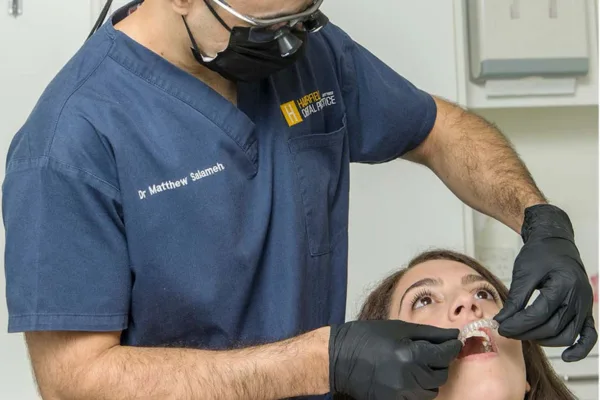
If you’re considering teeth straightening options, you’ve come to the right place. In this post, we’ll be diving into the age-old debate of Invisalign vs. Braces, two popular choices for achieving that perfectly aligned smile.
Having straight teeth not only enhances your appearance but also contributes to better oral health and overall well-being. However, the decision between Invisalign and traditional braces is not one to be taken lightly. It’s essential to find the option that best suits your individual needs and lifestyle.
In this comprehensive blog, we’ll walk you through the ins and outs of both Invisalign and braces. We’ll discuss their respective advantages, disadvantages, and treatment costs to help you make an informed choice.
So, if you’re ready to embark on the journey of teeth straightening, join us as we explore the world of these teeth straightening options, Let’s find out which option aligns perfectly with your desires and goals, so you can confidently smile your way to a brighter future.
Understanding Invisalign
If you’re seeking a discreet and effective way to straighten your teeth, It might be the perfect solution for you. It is a revolutionary teeth-straightening treatment that offers a clear and virtually invisible alternative to traditional braces.
What is Invisalign and How Does it Work?
It utilises a series of clear, custom-made aligners to gradually shift your teeth into their desired positions. These aligners are made from smooth, BPA-free plastic and are designed specifically for your teeth using advanced 3D imaging technology. Each set of aligners is worn for about two weeks, after which you’ll switch to the next set, bringing your teeth one step closer to their final alignment.
One of the key advantages of that is its ability to address various orthodontic issues, including spacing, crowding, and bite problems, providing an all-in-one solution for a wide range of dental concerns.
Advantages of Invisalign
It offers numerous benefits that make it a popular choice among adults and teenagers alike:
- Virtually Invisible: These aligners are clear and discreet, making them virtually unnoticeable to others. You can confidently smile, speak, and attend social events without feeling self-conscious about wearing braces.
- Removable: Unlike traditional braces, These aligners are removable. This means you can take them out for eating, drinking, and special occasions, allowing you to enjoy your favourite food without any restrictions.
- Easy to Clean: Maintaining good oral hygiene with Invisalign is a breeze. Since the aligners are removable, you can easily brush and floss your teeth without any obstructions or difficulties.
- Comfortable: They are made from smooth plastic, which means they won’t irritate the inside of your mouth like metal braces often do. They offer a more comfortable teeth-straightening experience.
Understanding Braces
Traditional options have been a reliable and time-tested method for straightening teeth for many years. They consist of metal brackets and wires that work together to gradually move your teeth into their proper positions.
Description and Function of Traditional Braces:
Traditional options are made up of small metal brackets that are attached to the front surface of your teeth using a special dental adhesive. These brackets are connected by thin arch wires, which exert gentle pressure on your teeth, guiding them into their desired alignment over time.
Orthodontic elastics, also known as ligatures or rubber bands, are often used to hold the arch wires in place and apply additional pressure to specific teeth to address individual dental issues, such as correcting overbites or underbites.
Regular visits to your orthodontist are essential during the treatment to adjust the wires and elastics as needed, ensuring a controlled and gradual movement of your teeth.
Types of Braces:
Over the years, advancements in orthodontic technology have led to the development of various types of them to cater to different needs and aesthetic preferences:
- Metal Braces: These are the most common type of dental straightening tool, consisting of stainless-steel brackets and wires. They are highly effective and often the most affordable option.
- Clear Braces: They are made from ceramic material that blends with the natural colour of your teeth, making them less noticeable than traditional metal braces. They are a popular choice for those seeking a more discreet treatment option.
- Lingual Braces: They are attached to the back surface of your teeth, making them completely hidden from view. They offer an excellent cosmetic solution for patients who wish to keep their orthodontic treatment discreet.
Advantages of Braces:
- Effective for Complex Cases: They are highly effective in treating complex dental issues, including severe crowding, spacing problems, and significant misalignments.
- Controlled Movement: Since they are fixed in place, they provide continuous and precise control over the movement of your teeth, allowing for a more predictable outcome.
- Less Compliance Dependent: Unlike Invisalign, braces are fixed and cannot be removed by the patient, which means there is no need to worry about wearing them consistently.
Disadvantages of Braces:
- Visible Appearance: The most apparent drawback of them is their visibility, which can be a concern for individuals seeking a more discreet treatment option.
- Oral Hygiene Challenges: They can make brushing and flossing more challenging, as they create additional surfaces for food particles and plaque to accumulate.
- Discomfort and Irritation: The brackets and wires may cause temporary discomfort and irritation on the cheeks and lips as the mouth adjusts to their presence.
Ultimately, the choice between Invisalign and braces depends on your specific dental needs, lifestyle preferences, and treatment goals.
Comparing Invisalign vs. Braces
When it comes to teeth straightening, both Invisalign and braces offer effective solutions, each with its own set of advantages. To help you make an informed decision, let’s compare these two popular options based on various factors:
| Factor | Invisalign | Braces |
| Removability | Removable aligners | Fixed brackets and wires |
| Visibility | Virtually invisible | Noticeable, especially metal braces |
| Treatment Time | 6-24 months* | 12-18 months* |
| Lifestyle Flexibility | Can be removed for eating and special occasions | Not removable, always in place |
| Oral Hygiene | Easy to clean | Requires extra care, harder to clean |
| Comfort | Smooth plastic aligners, minimal irritation | May cause temporary discomfort and irritation |
| Treatment Plan | Customised to individual needs | Fixed treatment plan |
| Complex Cases | Suitable for mild to moderate cases | Effective for complex dental issues |
| Adjustments | Visits every 6 weeks | Visits every 4 weeks |
| Investment | Similar to braces, may vary by provider | Similar to Invisalign, varies by provider |
*Treatment time may vary depending on individual cases.
Importance of Seeking Professional Advice:
While the comparison table provides a general overview, it’s crucial to remember that every individual’s dental needs are unique. Seeking advice from a dental professional orthodontist, is the key to determining the best teeth-straightening option for you.
FAQ’s
Q: Which treatment is faster, Invisalign or braces?
A: The treatment speed can vary depending on individual cases and compliance. In some cases, Invisalign may be faster than braces, while in others, braces may yield faster results. During your consultation your dental specialist will assess your specific dental needs and provide you with a more accurate estimate of the treatment duration.
Q: Are braces more painful than Invisalign?
A: Both of them may cause some discomfort as your teeth adjust to the pressure of the treatment. However, many patients find that these aligners are more comfortable than braces. Its smooth plastic surface reduces irritation to the cheeks and lips, which is common with braces. Overall, the level of discomfort is usually manageable and temporary for both treatments.
Q: What Do orthodontists prefer among these two?
A: The preference can vary among orthodontists and dentists based on their experience and treatment philosophy. Some may have more expertise in one treatment option over the other.
Q: How does the cost of Invisalign compare to braces?
A: The cost of them may vary depending on individual treatment requirements and the provider. During your consultation, your dentist Ashfield will provide you with transparent information about the costs and payment options available.
Q: Why should I schedule a free Invisalign consultation at Haberfield Dental Practice?
A: Our free Invisalign consultation offers you the opportunity to receive expert advice from myself Dr. Matthew Salameh, as I carry extensive experience in both treatments. During the consultation, at our dental clinic Haberfield, we will conduct a thorough examination, discuss your treatment goals, and answer any questions or concerns you may have. You will receive personalised recommendations and a clear understanding of what to expect during your teeth-straightening journey. Don’t miss this chance to take the first step towards your transformed smile!
Remember, your smile is a valuable investment in your self-confidence and oral health. Let us help you achieve the smile of your dreams with Invisalign or braces – the choice that perfectly aligns with your desires and needs.